
wRC+ is not exposed by the MLB Stats API, so we surface the two closest proxies for an instant read on hitting quality.
wRC+ scales overall offense to 100 = league average, adjusting for park factors and league context. Because the MLB Stats API does not expose wRC+ directly, we display the two closest proxies: OPS+ (OPS divided by the MLB average .720) and xwOBA (expected wOBA derived from exit velocity and launch angle). OPS+ 100 is league average; 130+ is roughly equivalent to an All-Star caliber wRC+ 130, and 150+ approaches MVP territory. xwOBA averages around .320; anything north of .400 marks elite contact quality.
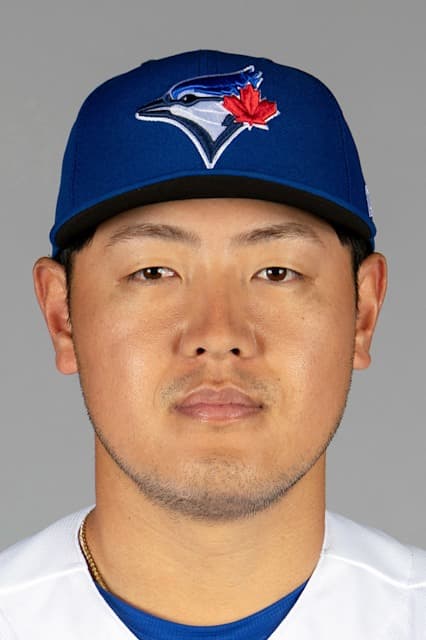
In 2026, Kazuma Okamoto is making his MLB debut with the Toronto Blue Jays as the first Japanese position player in franchise history. Through 27 games — exactly one month into his MLB career (as of April 27) — his .222 AVG / 5 HR / 11 RBI / .700 OPS shows steady improvement as he adapts to MLB pitching. The 5 home runs confirm the power is translating. Okamoto's 2026 home run count, RBI, and MLB rankings are updated daily on this page.
Kazuma Okamoto was drafted first overall by the Yomiuri Giants in 2016 from Chiben Gakuen High School in Nara, quickly establishing himself as Japan's premier right-handed power hitter. He reached the majors in 2017 and became a regular by 2018. In 2019, he claimed his first home run title (31 HR) and RBI title. After consistent 30-plus HR seasons in 2020–2021, he won a second home run crown (39 HR) and RBI title in 2021. His 2022 season — 44 HR, .275 AVG, .910 OPS — was his personal best, earning him a third consecutive home run and RBI title. Named team captain in 2023, Okamoto led the Giants both on and off the field through the 2025 season. A 2023 WBC World Series champion with Japan, he compiled over 230 career home runs in nine NPB seasons before signing with the Toronto Blue Jays for his MLB debut in 2026. The defining characteristic of Okamoto's swing is rare for a right-handed power hitter: he can drive the ball with authority to the opposite field (right-center) just as easily as he can pull it. Most right-handed sluggers work exclusively to the pull side, but Okamoto's ability to stay through the ball and punish pitchers who attack the outer half is a key reason scouts project him as more than a pure pull hitter. That same skill makes him difficult to neutralize with the standard MLB strategy of working away-heavy against right-handers. From a sabermetric perspective, the key metrics to watch in 2026 are OPS (on-base plus slugging) and wRC+ (weighted Runs Created Plus, which adjusts for park and league). His NPB career OPS consistently exceeded .850. His Gold Glove-caliber defense at first base is also important — it keeps him in the everyday lineup rather than limiting him to a DH role, which directly affects his counting stats. Rogers Centre ranks among the top home run parks in the AL, which could help inflate his counting stats while he adjusts to MLB pitching.
Loading season chart…
| Year | Team | G | AB | H | HR | RBI | SB | AVG | OBP | SLG | OPS |
|---|---|---|---|---|---|---|---|---|---|---|---|
| 2026BEST | - | 51 | 184 | 40 | 10 | 27 | 0 | .217 | .300 | .413 | .713 |
| Career | - | 51 | 184 | 40 | 10 | 27 | 0 | .217 | .300 | .413 | .713 |
OAA is Statcast's flagship defensive metric — it measures how many outs a fielder records above what an average fielder would on the same batted balls. +5 is above average, +10+ is Gold Glove caliber. Okamoto's 2026 OAA is updated weekly on this page in both the "2026 Defensive Summary" H2 section and the Defensive Metrics card (sourced from Baseball Savant's public leaderboard). First base is a position where OAA tends to be compressed compared to outfield, so it's most useful read alongside Fielding Runs Prevented — together they show how Okamoto's glove is contributing within the limited opportunities his position offers.
DRS (Defensive Runs Saved) and UZR (Ultimate Zone Rating) are well-known FanGraphs defensive metrics. This site standardizes on Baseball Savant's OAA and Fielding Runs Prevented (FRP) as the primary defensive read. FRP converts OAA into runs saved versus an average fielder — the same "runs prevented" scale as DRS, so the two are directly comparable. Okamoto's 2026 DRS-equivalent value is shown in the "2026 Defensive Summary" section alongside OAA and fielding percentage. For UZR specifically, refer to the FanGraphs page.
Okamoto's latest 2026 stats are updated daily in the stats box at the top of this page. Home runs, RBI, batting average, and OPS are tracked in real time. As the first Japanese position player in Blue Jays history, he is a key run producer in the middle of Toronto's lineup.
Through April 27 — exactly one month into his MLB career — Okamoto is hitting .222 with 5 HR, 11 RBI, and a .700 OPS over 27 games. Five home runs in his first month projects to roughly 30 HR over a full 162-game season, a credible MLB debut pace for a power hitter still adjusting. His 12 walks against 35 strikeouts suggest plate discipline is starting to surface, and the May-June trend will define how his 3x NPB Home Run King power profile (career-high 44 HR / .910 OPS in 2022) translates over a full season.
Okamoto has 5 home runs and a .700 OPS through 27 games (as of April 27) in his MLB debut season with the Blue Jays. The .700 OPS is below his .850+ NPB career average, but the 5 HR confirms the power is translating — opposite-field shots have been part of the mix, validating the all-fields slugger profile that scouts projected. Rogers Centre's above-average home run park factor remains a structural advantage as he settles into MLB pitching.
OPS (On-base Plus Slugging) is the sum of on-base percentage and slugging percentage — a quick measure of a hitter's run-producing value. MLB average OPS is roughly .720–.730; .850+ is All-Star caliber. wRC+ (weighted Runs Created Plus) adjusts for park and era, with 100 being league average and 120+ indicating an above-average hitter. Okamoto's NPB career OPS consistently exceeded .850, and his broad contact profile (hitting to all fields) projects a wRC+ in the 110–130 range once he adjusts to MLB.
The key challenges in Year 1 are: (1) adjusting to high-velocity breaking balls — especially sliders and cut fastballs thrown by AL pitchers; (2) adapting to a slightly wider MLB strike zone; and (3) getting comfortable with Rogers Centre's dimensions. His biggest advantage is his ability to drive the ball the other way with power — a rare skill for a right-handed slugger that translates well against MLB pitchers who work the outer half heavily.
Okamoto won three NPB home run titles with the Yomiuri Giants: 31 HR in 2019, 39 HR in 2021, and 44 HR in 2022, along with three RBI titles in the same years. His 2022 season — 44 HR and a .910 OPS — was his personal best, and he finished his nine-year NPB career with over 230 home runs. That track record of elite, sustained power production is why he signed a major-league deal with Toronto.
The "Season Analysis" section below the main stats box shows monthly charts for batting average, home runs, and OPS. You can see how his numbers trend from the early adjustment phase (March–April) through the dog days of summer, and compare home performance at Rogers Centre versus away games.
The defining feature of Okamoto's swing is his ability to drive the ball with real power to the opposite field (right-center) — something most right-handed sluggers cannot do consistently. By staying through the ball longer (an inside-out path through the zone), he can wait on outside pitches and punish them to right-center rather than rolling over to weak grounders. This opposite-field power is exactly what MLB scouts value most, because it means standard away-heavy pitching plans don't automatically shut him down. It's the main reason evaluators project him as more than a pull-side-only threat in the AL.
Yes — Rogers Centre consistently ranks among the top home run parks in MLB, with a park factor above 1.0 for home runs. The closed roof eliminates wind suppression (a major factor in outdoor stadiums), and the dimensions are favorable for right-handed pull hitters and opposite-field power hitters alike. Okamoto's power profile suits Rogers Centre well, and the controlled indoor environment also removes weather-related performance swings. The key thing to watch: compare his home and away splits. Some players post inflated numbers at home but struggle in pitcher-friendly parks like Fenway or Camden Yards.
Among all Japanese MLB hitters, Hideki Matsui (Yankees) is the closest comparison to Okamoto — both are right-handed corner sluggers with strong opposite-field power and above-average plate discipline. Matsui spent seven MLB seasons and finished with 175 HR and a .832 OPS. Okamoto's NPB profile (3 HR titles, .850+ career OPS) arguably exceeds where Matsui was when he came over. Ichiro was a completely different archetype — contact/speed, not power. Looking at the broader history of Japanese position players in MLB, true power hitters who maintained above-.800 OPS over multiple seasons are rare, which makes Okamoto's 2026 season a significant data point for how elite NPB sluggers translate to MLB.
Okamoto's today plate appearances (AB, hits, HR, RBI) are updated daily on the dedicated "Today" page. Pitch-by-pitch breakdowns, exit velocity, opposing pitcher arsenal, splits vs RHP/LHP, and a Unico AI analysis are all included. Live in-play updates run during the game; the final line and deeper analysis are posted by 18:00 JST after the game ends.
Kazuma Okamoto plays for the Toronto Blue Jays as a first baseman / DH. He signed via the posting system after the 2025 season and is the first Japanese position player in Blue Jays franchise history, anchoring the middle of Toronto's lineup in 2026. He bats and throws right-handed.
Loading…
Side-by-side season-stat comparisons featuring Kazuma Okamoto against other Japanese MLB players.
Data: MLB Stats API · Auto-updated hourly
| Date | Opp | AB | H | HR | RBI | SB | BB | AVG |
|---|---|---|---|---|---|---|---|---|
| 05/25 | H PIT | 2 | 1 | 0 | 0 | 0 | 0 | .216 |
| 05/24 | H PIT | 0 | 0 | 0 | 0 | 0 | 0 | .213 |
| 05/23 | H PIT | 4 | 0 | 0 | 0 | 0 | 0 | .213 |
| 05/22 | @ NYY | 4 | 0 | 0 | 0 | 0 | 0 | .218 |
| 05/21 | @ NYY | 4 | 0 | 0 | 0 | 0 | 0 | .223 |
| 05/20 | @ NYY | 4 | 0 | 0 | 0 | 0 | 1 | .228 |
| 05/19 | @ NYY | 4 | 1 | 0 | 0 | 0 | 0 | .234 |
| 05/17 | @ DET | 4 | 0 | 0 | 0 | 0 | 0 | .233 |
| 05/16 | @ DET | 4 | 1 | 0 | 0 | 0 | 0 | .239 |
| 05/14 | H TB | 2 | 0 | 0 | 1 | 0 | 2 | .239 |
| Date | Opp | AB | H | HR | RBI | SB | BB | AVG |
|---|---|---|---|---|---|---|---|---|
| 05/25 | H PIT | 2 | 1 | 0 | 0 | 0 | 0 | .216 |
| 05/24 | H PIT | 0 | 0 | 0 | 0 | 0 | 0 | .213 |
| 05/23 | H PIT | 4 | 0 | 0 | 0 | 0 | 0 | .213 |
| 05/22 | @ NYY | 4 | 0 | 0 | 0 | 0 | 0 | .218 |
| 05/21 | @ NYY | 4 | 0 | 0 | 0 | 0 | 0 | .223 |
| 05/20 | @ NYY | 4 | 0 | 0 | 0 | 0 | 1 | .228 |
| 05/19 | @ NYY | 4 | 1 | 0 | 0 | 0 | 0 | .234 |
| 05/17 | @ DET | 4 | 0 | 0 | 0 | 0 | 0 | .233 |
| 05/16 | @ DET | 4 | 1 | 0 | 0 | 0 | 0 | .239 |
| 05/14 | H TB | 2 | 0 | 0 | 1 | 0 | 2 | .239 |
In-depth metrics aggregated from every at-bat and pitch. Collapsed by default.
Data as of: 2026-05-17
Green = improvement, red = decline. "—" means no data in the same month last year.
Batting
| Mar | Apr | May | |
|---|---|---|---|
| AVG | — | — | — |
| HR | — | — | — |
| OPS | — | — | — |
118 batted balls this season. Gold = Barrel, white border = HR. Shaded band is sweet spot (8–32°).
OAA (Outs Above Average) is Statcast's signature defensive metric — it measures how many outs a fielder makes above (or below) what an average fielder would on the same batted balls. +5 is above average, +10+ is Gold Glove caliber. Fielding Runs Prevented translates that into the same scale as offensive value (runs), making it directly comparable to a hitter's contribution.
UZR (Ultimate Zone Rating) — UZR is a well-known FanGraphs defensive metric, but this site does not compute it. We standardize on Baseball Savant's OAA / Fielding Runs Prevented as the primary defensive read.
Kazuma Okamoto's 2026 OAA is +1. OAA is Statcast's flagship defensive metric: it measures how many outs a fielder records above what an average fielder would on the same batted balls. +5 is above average, +10+ is Gold Glove caliber. Data is sourced from Baseball Savant's public leaderboard and refreshed every Monday.
Kazuma Okamoto's 2026 DRS-equivalent value is +1.0 (shown as Fielding Runs Prevented on the runs-saved scale). DRS (Defensive Runs Saved) is the FanGraphs-side counterpart metric — both convert defensive value into runs, so the two are directly comparable. This site standardizes on Savant's OAA / FRP rather than running its own DRS calculation.
UZR (Ultimate Zone Rating) is a FanGraphs-only defensive metric. This site does not compute UZR — for UZR specifically, refer to Kazuma Okamoto's FanGraphs page. We standardize on Statcast OAA / FRP as the primary defensive read.
Comprehensive 2026 season analysis generated by Claude AI from stats data.
Through 41 games, Okamoto carries a .242/.326/.464 line with 10 home runs and 26 RBI, producing a .790 OPS. Relative to MLB averages (.279/.361/.469/.824), he sits below the mean in batting average and on-base percentage, and slightly trails in slugging. The OPS lands between the league P50 (.814) and the broader average, placing him in roughly the middle third of qualified hitters. His home run pace, however, already reaches the league P75 mark of 9 and edges past it, signaling that his offensive value is being driven primarily by power output rather than contact or on-base skills at this stage.
The clearest strength is over-the-fence power. Ten homers in 41 games projects favorably against the MLB P75 benchmark and reflects the pull-side authority that defined his NPB profile. A .464 slugging mark, just under the league average of .469, indicates his extra-base damage is translating despite the contact dip. The .138 isolated power figure stands as the most stable, MLB-caliber tool in his profile so far. He has also drawn enough walks to lift his OBP roughly 84 points above his average, suggesting acceptable plate discipline against unfamiliar pitching arsenals during the adjustment window.
Batting average is the most visible gap. A .242 mark sits 37 points below the MLB average and 31 points beneath the P50, pointing to contact quality and pitch recognition still adapting to higher-velocity, higher-spin sequencing. The .326 OBP also lags the league mean by 35 points, indicating he has not yet found a sustainable count-leverage approach. The OPS shortfall against P75 (.872) is roughly 80 points, meaning his overall offensive contribution remains below what teams typically expect from a regular corner infielder once power is normalized across the league.
The reasonable expectation for the remainder of the season is gradual stabilization rather than a sharp leap. If the home run pace holds, even a modest 15 to 20 point gain in batting average, plausible as he sees the same arms a second and third time, would lift his OPS into the .820 to .850 range, closer to league average. Watch areas include performance against breaking balls below the zone and two-strike contact rates. A continued power output combined with incremental contact gains would position him as an average to slightly above-average MLB bat by season's end.
AI-generated content (Claude)
Percentile rank against all MLB players (P25/P50/P75/P90). Triangle = player, line = MLB avg.
Aggregated from 118 balls in play this season.
Situational splits for the current season. See strengths and weaknesses by scenario.
| Split | PA | AVG | OBP | SLG | OPS | HR |
|---|---|---|---|---|---|---|
| vs RHP | 143 | .220 | .301 | .465 | .766 | 9 |
| vs LHP | 42 | .278 | .381 | .389 | .770 | 1 |
2026 Season · Most PA First (5+ PA)
Career-long performance trends for every key stat. How does this year compare to history?
| Season | G | HR | RBI | AVG | OBP | SLG | OPS |
|---|---|---|---|---|---|---|---|
| 2026Now | 44 | 10 | 27 | .233 |
Red bars are Hard-Hit (≥95 mph).
| Split | PA | AVG | OBP | SLG | OPS | HR |
|---|---|---|---|---|---|---|
| Home | 96 | .235 | .313 | .400 | .713 | 4 |
| Away | 89 | .231 | .326 | .500 | .826 | 6 |
| .421 |
| 1.484 |
| Yankee StadiumNYY | 17 | 16 | 1 | 0 | .063 | .118 | .180 |
| Chase FieldARI | 13 | 12 | 4 | 1 | .333 | .385 | 1.051 |
| Tropicana FieldTB | 13 | 11 | 4 | 1 | .364 | .462 | 1.189 |
| Rate FieldCWS | 12 | 10 | 1 | 0 | .100 | .250 | .350 |
| American Family FieldMIL | 12 | 11 | 2 | 0 | .182 | .250 | .432 |
| Angel StadiumLAA | 12 | 10 | 1 | 0 | .100 | .250 | .350 |
.448 |
.767 |
Older games on the left, most recent on the right. Color shows how they played.
Best: HR or 3+H · Good: 2H · OK: 1H · BB only · no hit
All 51 games of the 2026 season. Showing latest 10; click to expand.
| Date | Opp | AB | H | HR | RBI | BB | K | AVG |
|---|---|---|---|---|---|---|---|---|
| 05/25 | vs PIT | 2 | 1 | 0 | 0 | 0 | 0 | .500 |
| vs PIT | 0 | 0 | 0 | 0 | 0 | 0 | .000 | |
| vs PIT | 4 | 0 | 0 | 0 | 0 | 4 | .000 | |
| @ NYY | 4 | 0 | 0 | 0 | 0 | 2 | .000 | |
| @ NYY | 4 | 0 | 0 | 0 | 0 | 3 | .000 | |
| @ NYY | 4 | 0 | 0 | 0 | 1 | 1 | .000 | |
| @ NYY | 4 | 1 | 0 | 0 | 0 | 3 | .250 | |
| @ DET | 4 | 0 | 0 | 0 | 0 | 1 | .000 | |
| @ DET | 4 | 1 | 0 | 0 | 0 | 2 | .250 | |
| vs TB | 2 | 0 | 0 | 1 | 2 | 0 | .000 |
| Date | Opp | AB | H | HR | RBI | BB | K | AVG |
|---|---|---|---|---|---|---|---|---|
| vs TB | 4 | 0 | 0 | 0 | 1 | 2 | .000 |
| 05/12 | vs TB | 4 | 1 | 0 | 0 | 0 | 2 | .250 |
| 05/11 | vs LAA | 4 | 1 | 0 | 1 | 0 | 1 | .250 |
| 05/10 | vs LAA | 4 | 1 | 0 | 1 | 0 | 0 | .250 |
| 05/09 | vs LAA | 3 | 1 | 0 | 1 | 1 | 1 | .333 |
| 05/07 | @ TB | 3 | 1 | 0 | 0 | 1 | 0 | .333 |
| 05/06 | @ TB | 4 | 2 | 1 | 1 | 0 | 2 | .500 |
| 05/05 | @ TB | 4 | 1 | 0 | 0 | 1 | 2 | .250 |
| 05/04 | @ MIN | 4 | 1 | 1 | 2 | 1 | 2 | .250 |
| 05/03 | @ MIN | 5 | 2 | 1 | 2 | 0 | 0 | .400 |
| 05/02 | @ MIN | 4 | 2 | 2 | 3 | 1 | 0 | .500 |
| 05/01 | @ MIN | 3 | 0 | 0 | 0 | 1 | 0 | .000 |
| 04/30 | vs BOS | 4 | 1 | 0 | 2 | 0 | 2 | .250 |
| 04/29 | vs BOS | 4 | 1 | 0 | 2 | 0 | 1 | .250 |
| 04/28 | vs BOS | 3 | 0 | 0 | 0 | 0 | 0 | .000 |
| 04/27 | vs CLE | 3 | 0 | 0 | 0 | 0 | 1 | .000 |
| 04/26 | vs CLE | 3 | 2 | 1 | 2 | 1 | 1 | .667 |
| 04/25 | vs CLE | 3 | 2 | 1 | 1 | 1 | 1 | .667 |
| 04/23 | @ LAA | 3 | 1 | 0 | 0 | 1 | 1 | .333 |
| 04/22 | @ LAA | 4 | 0 | 0 | 0 | 0 | 1 | .000 |
| 04/21 | @ LAA | 3 | 0 | 0 | 0 | 1 | 1 | .000 |
| 04/20 | @ ARI | 4 | 2 | 1 | 3 | 1 | 2 | .500 |
| 04/19 | @ ARI | 4 | 2 | 0 | 1 | 0 | 2 | .500 |
| 04/18 | @ ARI | 4 | 0 | 0 | 0 | 0 | 1 | .000 |
| 04/17 | @ MIL | 4 | 0 | 0 | 0 | 0 | 1 | .000 |
| 04/16 | @ MIL | 3 | 0 | 0 | 0 | 1 | 1 | .000 |
| 04/15 | @ MIL | 4 | 2 | 0 | 1 | 0 | 1 | .500 |
| 04/13 | vs MIN | 4 | 0 | 0 | 0 | 1 | 1 | .000 |
| 04/11 | vs MIN | 4 | 0 | 0 | 0 | 0 | 0 | .000 |
| 04/09 | vs LAD | 4 | 0 | 0 | 0 | 0 | 1 | .000 |
| 04/08 | vs LAD | 4 | 1 | 0 | 0 | 0 | 1 | .250 |
| 04/07 | vs LAD | 4 | 2 | 0 | 0 | 0 | 1 | .500 |
| 04/06 | @ CWS | 3 | 0 | 0 | 0 | 1 | 2 | .000 |
| 04/05 | @ CWS | 3 | 1 | 0 | 0 | 1 | 0 | .333 |
| 04/04 | @ CWS | 4 | 0 | 0 | 0 | 0 | 4 | .000 |
| 04/02 | vs COL | 4 | 1 | 0 | 0 | 0 | 2 | .250 |
| 04/01 | vs COL | 5 | 1 | 0 | 1 | 0 | 3 | .200 |
| 03/31 | vs COL | 3 | 1 | 1 | 1 | 1 | 2 | .333 |
| 03/30 | vs OAK | 4 | 1 | 1 | 1 | 0 | 1 | .250 |
| 03/29 | vs OAK | 5 | 1 | 0 | 0 | 1 | 2 | .200 |
| 03/28 | vs OAK | 3 | 2 | 0 | 0 | 1 | 1 | .667 |