
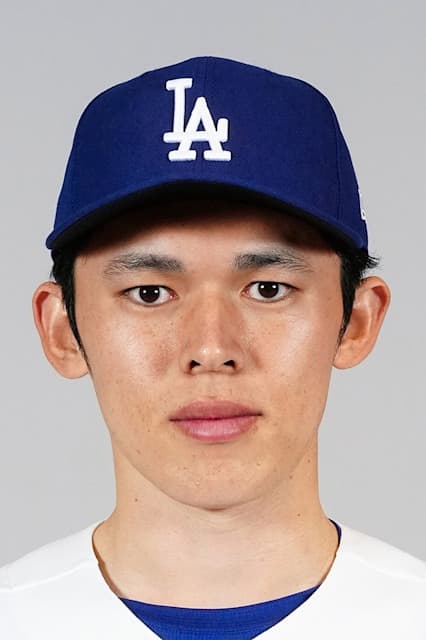
Roki Sasaki — the "Monster of the Reiwa Era" — brings NPB's youngest-ever perfect game and a 102.5 mph fastball into his real Dodgers Year 1 in 2026, joining Ohtani and Yamamoto as the third pillar of an unprecedented Japanese rotation. His NPB resume (1.85 career ERA, K/9 11.96 over five seasons) sets the ceiling, and an Opening Day rotation slot means every 2026 start adds to that picture. Through 5 starts (as of April 27), the line reads 1-2, 6.35 ERA, 1.81 WHIP over 22.2 IP — the swing-and-miss arsenal is intact, and command (13 BB, K/9 ~8.74) is the lever that bends the trajectory back toward his NPB form. The May–June recovery is one of the most compelling pitcher development stories in the Dodgers rotation.
In 2026, Roki Sasaki is pitching what amounts to his true "Dodgers Year 1." His 2025 MLB debut was cut short by a right shoulder injury after just 10 starts — not enough to form a reliable sample on his real ceiling. This season, with a full Opening Day rotation slot, every start adds to the picture of what the "Monster of the Reiwa Era" can do at the highest level. The stats box above is updated daily — follow along as the story unfolds. Sasaki is a right-handed power pitcher who threw a perfect game in NPB at age 20 in April 2022 — the youngest ever in Japanese professional baseball. A first-round pick by the Lotte Marines in 2019 from Ofunato High School in Iwate Prefecture, he dominated NPB for five seasons with a career ERA of 1.85 and a K/9 of 11.96 — one of the highest rates in modern Japanese baseball. His arsenal is built around a four-seam fastball (55% usage) that touches 165km/h (102.5mph) and a diving forkball (35% usage) that generates elite swing-and-miss rates at high velocity. Key metrics to watch in 2026: his walk rate (BB/9 improvement), durability (reaching the innings threshold), and maintaining his elite K/9. A healthy full season projects to a sub-3.00 ERA and 180+ strikeouts — numbers that would cement his status as one of baseball's elite starters.
9 starts · 43 total strikeouts
| Date | Opp | IP | K | HR | BB | Dec |
|---|---|---|---|---|---|---|
| 5/24 | @MIL | 5.0 | 4 | - | 2 | W |
| 5/18 | @LAA | 7.0 | 8 | - | 0 | W |
| 5/12 |
Roki Sasaki's NPB career with the Chiba Lotte Marines (2019–2024) stands as one of the most dominant pitching runs in modern Japanese baseball history. After being drafted first overall in 2019 from Ofunato High School in Iwate, he sat out his first professional season under a careful development plan. He made his debut in 2020, then steadily progressed: a 2.27 ERA in 19 starts in 2021, and a 2.02 ERA in 20 starts in 2022. On April 10, 2022, Sasaki threw a perfect game against the Orix Buffaloes at age 20 years, 4 months — retiring all 27 batters with 13 strikeouts to become the youngest perfect game pitcher in NPB history. Remarkably, he followed that with 8⅔ perfect innings in his very next start before giving up a hit — an unprecedented back-to-back run of perfection that cemented his "Monster of the Reiwa Era" nickname. In 2023, he represented Japan at the WBC and pitched a crucial late-inning stint in the championship game against the U.S. alongside Shohei Ohtani, helping Japan win the title. That same NPB season he posted a 1.78 ERA over 22 starts. His final NPB season in 2024 was his best: 1.09 ERA, 174 strikeouts, and a 23-start run that ranks among the finest single seasons in Japanese baseball history. His NPB career totals — 95 appearances, 1.85 ERA, 11.96 K/9 — are simply without peer in the modern era.
Loading season chart…
| Year | Team | APP | GS | W | L | ERA | IP | K | WHIP | SV |
|---|---|---|---|---|---|---|---|---|---|---|
| 2025BEST | - | 10 | 8 | 1 | 1 | 4.46 | 36.1 | 28 | 1.43 | 0 |
| 2026BEST | - | 9 | 9 | 3 | 3 | 4.93 | 45.2 | 43 | 1.42 | 0 |
| Career | - | 19 | 17 | 4 | 4 | 4.72 | 82.0 | 71 | 1.43 | 0 |
Roki Sasaki's 2026 performance through 5 starts (as of April 27): 1-2 record, 6.35 ERA, 22 strikeouts, 1.81 WHIP in 22.2 IP. The K/9 of about 8.74 sits below his NPB pace (11.96), and 13 walks (BB/9 ~5.16) have inflated the ERA. The fastball/forkball arsenal is unchanged from his NPB form — the bottleneck is command. As the third pillar of the Dodgers' Japanese rotation alongside Shohei Ohtani (0.38 ERA) and Yoshinobu Yamamoto (2.87 ERA), his recovery trajectory is one of the most-watched pitching stories in the NL West. The latest line is updated daily in the stats box at the top of this page.
Sasaki's 2026 performance trends so far reveal a classic NPB-to-MLB adjustment curve. The headline numbers (6.35 ERA, 1.81 WHIP) are inflated by walks (13 in 22.2 IP, BB/9 ~5.16), not by loss of stuff — fastball velocity still touches 102 mph and the forkball whiff rate is comparable to his NPB peak. Start-by-start, his walk rate is the metric to watch: the trajectory bends sharply on outings where he stays in the strike zone with the fastball, even when the forkball comes off the plate. Compared to his NPB performance baseline (1.85 career ERA, K/9 11.96), the 2026 sample is still in adjustment phase — the year-over-year performance trend chart and the daily stats box at the top of this page show how each new start updates the picture.
Sasaki's 2026 ERA is 6.35 through 5 starts (22.2 IP, as of April 27, 2026). The walks (13 BB, BB/9 ~5.16) are the primary driver — opposing hitters are sitting on his fastball when he falls behind and laying off the forkball when it doesn't finish in the zone. His NPB career ERA was 1.85 across five seasons, and the Dodgers staff expects a sub-4.00 ERA range once command stabilizes. The live ERA, WHIP, and K total are refreshed daily, so check the stats box at the top for the latest numbers.
Sasaki throws a four-seam fastball that touches 165km/h (102.5 mph) — top-of-scale velocity for any MLB starter — paired with a diving forkball at ~145km/h (90 mph) that drops out of the strike zone late. The 12+ mph velocity differential between the two is among the largest in the league, and his forkball whiff rate ranks in the elite tier among MLB starters. By usage, the four-seam sits around 55% and the forkball around 35% in 2026, with sliders and other shapes filling the remaining mix. When command is on, the fastball/forkball pairing alone is enough to overpower MLB hitters — that is exactly the K/9 11.96 profile he posted in NPB and the ceiling Dodgers fans are waiting to see translate fully.
Sasaki's latest 2026 stats are updated daily in the stats box at the top of this page. Through 5 starts (as of April 27, 2026): 1-2, 6.35 ERA, 22 K, 1.81 WHIP, 22.2 IP. Think of 2026 as his "Dodgers Year 1" — his 2025 debut was limited to 10 starts due to a shoulder injury, so this is the first full season where we can truly evaluate his MLB ceiling. He joined the Opening Day rotation alongside Shohei Ohtani and Yoshinobu Yamamoto, and each start adds to the picture of what the "Monster of the Reiwa Era" can do in the big leagues.
FIP (Fielding Independent Pitching) measures a pitcher's performance based only on outcomes he controls — strikeouts, walks, and home runs — removing the influence of defense. Sasaki's NPB career K/9 of 11.96 projects to elite FIP at the MLB level. An MLB FIP below 3.50 is considered ace-level; his electric fastball and swing-and-miss forkball give him the strikeout profile to achieve that.
K/9 (strikeouts per 9 innings) measures how often a pitcher gets strikeouts. Sasaki posted a career K/9 of 11.96 in NPB — a historically elite rate. MLB average K/9 is roughly 8.5–9.0, with aces hitting 10.0+. His BB/9 (walks per 9) was also strong, meaning his K-BB% (strikeout rate minus walk rate) was consistently excellent — a key indicator of true pitching quality.
Sasaki's arsenal features a four-seam fastball that reaches 165km/h (102.5mph) — one of the hardest in baseball — paired with a sharp, diving forkball as his out pitch. The forkball drops sharply out of the strike zone at high velocity, generating elite swing-and-miss rates. That two-pitch combination produced a 11.96 K/9 in NPB, the best mark in modern Japanese baseball history.
In January 2025, Sasaki signed with the Los Angeles Dodgers via the posting system. Key factors included being teammates with Shohei Ohtani (his 2023 WBC teammate) and Yoshinobu Yamamoto, the Dodgers' pitching development infrastructure, and the competitive environment. The chance to pitch alongside fellow Japanese stars on one of MLB's most storied franchises was a major draw.
Both are elite right-handers who dominated NPB before joining the Dodgers, but they differ in style. Yamamoto relies on precision and command of four pitches (fastball, curveball, cutter, splitter). Sasaki is a power pitcher — elite velocity (165km/h) plus a devastating forkball — and one of the most prolific strikeout pitchers in baseball. Together in 2026 alongside Ohtani, they form arguably the most formidable Japanese starting trio in MLB history.
Sasaki's next scheduled start and the line from his most recent outing (IP, K, ER, pitch count) are available in the stats box at the top of this page and on the dedicated "Today" page. Pitch usage by type (four-seam vs. forkball), swing-and-miss rates, splits vs RHB/LHB, opposing lineup notes, and a Unico AI commentary are updated daily. Live in-play updates run during the game; final results are posted by 18:00 JST.
Roki Sasaki plays for the Los Angeles Dodgers as a right-handed starting pitcher. He signed via the posting system in January 2025 and is in his "true Dodgers Year 1" in 2026 after a 2025 debut shortened by a right shoulder injury. He shares the rotation with Shohei Ohtani and Yoshinobu Yamamoto, forming the Dodgers' Japanese trio.
Loading…
Side-by-side season-stat comparisons featuring Roki Sasaki against other Japanese MLB players.
Data: MLB Stats API · Auto-updated hourly
Roki Sasaki 2026 performance snapshot: 6.35 ERA / 22 K / 1.81 WHIP through 5 starts (1-2 record, 22.2 IP, K/9 ~8.74, BB/9 ~5.16). 13 walks have inflated the ERA; the swing-and-miss arsenal is intact and command improvement is the path to ERA recovery in May/June
| vsSF |
| 5.0 |
| 5 |
| 1 |
| 1 |
| - |
| 5/3 | @STL | 6.0 | 4 | 1 | 2 | L |
| 4/26 | vsCHC | 5.0 | 5 | 3 | 1 | W |
| 4/20 | @COL | 4.2 | 2 | 1 | 2 | - |
| 4/13 | vsTEX | 4.0 | 6 | 1 | 5 | L |
| 4/6 | @WSH | 5.0 | 5 | 2 | 3 | - |
| 3/31 | vsCLE | 4.0 | 4 | - | 2 | L |
In-depth metrics aggregated from every at-bat and pitch. Collapsed by default.
Data as of: 2026-05-17
Green = improvement, red = decline. "—" means no data in the same month last year.
Pitching
| Mar | Apr | May | |
|---|---|---|---|
| ERA | -3.54 | +4.18 | -4.48 |
| K | -1 | +3 | +17 |
| WHIP | -1.29 | +0.77 | -0.63 |
Comprehensive 2026 season analysis generated by Claude AI from stats data.
Through 7 starts and 33.2 innings, Sasaki sits below MLB averages in the headline run-prevention metrics. His 5.88 ERA trails the MLB average of 3.48 by a wide margin and falls short of the P50 mark of 3.35. The 1.63 WHIP is similarly elevated against a league average of 1.19 and a P75 threshold of 1.02. On the bat-missing side, his 8.29 K/9 lands just below the MLB average of 8.51 and well shy of the P75 benchmark of 9.77. The current profile reads as a back-end rotation arm whose ratios need meaningful correction before he approaches league-average production.
The clearest year-over-year gain is in strikeout rate. Sasaki has lifted his K/9 from 6.94 in 2025 to 8.29 in 2026, a step up of roughly 1.35 punchouts per nine innings that brings him within range of the MLB average of 8.51. His 31 strikeouts in 33.2 frames indicate the swing-and-miss stuff is playing more consistently than a year ago. Workload distribution has also normalized slightly, with innings per start nudging upward from 3.63 in 2025 to 4.81 in 2026, suggesting modest gains in length and pitch efficiency relative to his rookie campaign.
Two areas trail the league baseline. His 4.28 BB/9 is well above the MLB average of 2.88 and far from the P75 threshold of 2.28, meaning free passes are arriving at roughly 1.5 times the league rate. That walk volume is the primary driver behind the 1.63 WHIP, which exceeds the MLB average of 1.19. The 5.88 ERA also lags the average of 3.48 by 2.40 runs. Until command tightens, every outing carries elevated baserunner traffic, which compounds damage potential and limits his ability to work deep into games without high pitch counts.
The path forward hinges on walk reduction. Trimming BB/9 from 4.28 toward the MLB average of 2.88 would directly compress the 1.63 WHIP and ease the run environment that has produced the current ERA. The strikeout improvement from 2025 suggests stuff quality is not the issue, so the focus is on in-zone consistency and first-pitch strikes. A realistic second-half target is an ERA closer to league average and a WHIP under 1.30, both contingent on command gains. Without that adjustment, the ratios will likely remain in the bottom quartile of MLB starters.
AI-generated content (Claude)
Older games on the left, most recent on the right. Color shows how they played.
Best: 6IP+ / ≤1ER · Good: 5IP+ / ≤2ER · OK: 4IP+ / ≤3ER · 4ER · ≥5ER (blowup)
Percentile rank against all MLB players (P25/P50/P75/P90). Triangle = player, line = MLB avg.
ERA vs right-handed and left-handed batters this season. Spot weaknesses by batter type.
| Split | ERA | IP | K | BAA |
|---|---|---|---|---|
| vs RHB | -.-- | 20.0 | 19 | .234 |
| vs LHB | -.-- | 25.2 | 24 | .284 |
Situational splits for the current season. See strengths and weaknesses by scenario.
| Split | OAVG | OOPS | HR | K | BB |
|---|---|---|---|---|---|
| vs RHB | .278 | .955 | 4 | 14 | 5 |
| vs LHB | .293 | .900 | 5 | 17 | 11 |
| Split |
|---|
Career-long performance trends for every key stat. How does this year compare to history?
| Season | G | IP | ERA | WHIP | K/9 | BB/9 | K |
|---|---|---|---|---|---|---|---|
| 2025 | 10 | 36.1 | 4.46 | 1.43 |
| OAVG |
|---|
| OOPS |
|---|
| HR |
|---|
| K |
|---|
| BB |
|---|
| Home | .297 | .942 | 5 | 20 | 9 |
| Away | .274 | .898 | 4 | 11 | 7 |
5.45 |
28 |
| 2026Now | 8 | 34.2 | 5.71 | 1.62 | 8.31 | 4.15 | 32 |