
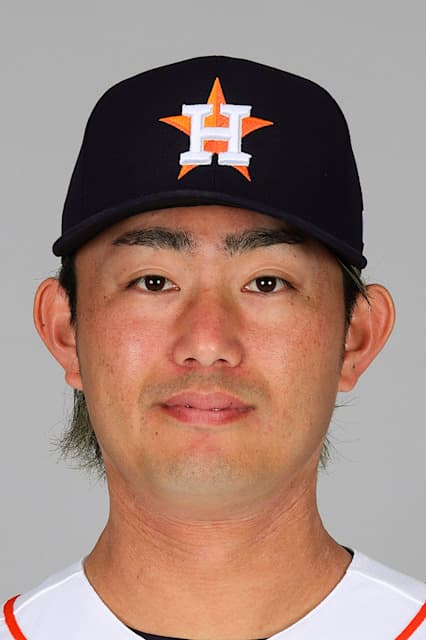
Tatsuya Imai signed a 3-year, $54M deal ($18M AAV) with the Houston Astros via the posting system in January 2026, breaking camp in the Opening Day rotation as the former Seibu Lions ace — the 2024 NPB strikeout leader and 2025 ERA leader at 1.92.
His early-season K/9 of about 13.5 ranks among the best for any MLB starter and is historic territory for a rookie. The mid-90s rising fastball paired with a sharp diving forkball is generating elite swing-and-miss in MLB, putting Imai squarely in the AL Rookie of the Year (ROY) conversation.
The gap is walks (BB/9 ~11). The Astros' renowned pitching development staff is targeting Zone% improvement; if command catches up, a 3-4 ERA mid-rotation arm with elite strikeout numbers is the realistic 2026 finish line. Closest comparable Japanese pitchers: Yoshinobu Yamamoto (Dodgers, year 3) and Kodai Senga (Mets, forkball-led starter).
In 2026, Tatsuya Imai is making his MLB debut with the Houston Astros after signing a 3-year, $54M deal in January. Through 3 starts (as of April 27): 1-0, 7.27 ERA, 13 K, 2.08 WHIP in 8.2 IP. The Opening Day outing (March 29 vs. Angels: 2.2 IP, 4 BB) was rough, but he answered with 9 strikeouts in his second start (April 4 vs. Athletics: 5.2 IP, 1 ER) for his first MLB win. His K/9 of ~13.5 ranks among MLB's best for starters, while walk prevention (11 BB through 8.2 IP, BB/9 ~11.4) is the gap separating good starts from elite ones. The Astros' renowned pitching development staff — the same group that refined Framber Valdez, Justin Verlander, and Cristian Javier — is now the key variable for whether Imai becomes a top-of-rotation arm or settles into a mid-rotation strikeout specialist.
Tatsuya Imai (Houston Astros) was drafted first overall by the Seibu Lions in 2018 out of Sakushin Gakuin High School in Tochigi Prefecture. He overcame early shoulder injuries and emerged as a dominant ace from 2022 onward — winning the NPB strikeout title in 2024 and posting a career-best 1.92 ERA in 2025 before making the leap to MLB. 【Pitch Arsenal & Style】Imai works primarily off a mid-90s (150km/h+) four-seam fastball that touches 97 mph, paired with a sharp diving forkball (splitter family, ~85 mph with negative-vertical break) and a sweeping slider in the low-to-mid 80s. The fastball-forkball combination is built on tunneling: both pitches share a release point and arm speed before the forkball drops late, which is why opposing hitters chase below the zone at high rates. The forkball generates elite swing-and-miss rates — evidenced by 13 strikeouts in his first three MLB starts (K/9: ~13.5, swinging-strike rate above 14%). Walk prevention (11 BB in 8.2 IP, BB/9 ~11.4) remains the key area for improvement on his way to becoming a front-of-rotation arm. The Astros' development plan focuses on improving Zone% (in-zone pitch rate) without sacrificing the chase-inducing forkball usage. 【Team & Environment】The two-time World Series champion Astros (2017, 2022) are renowned for elite pitching development — turning Justin Verlander, Cristian Javier, Framber Valdez, and Luis García into front-line arms. Pitching coach Josh Miller and general manager Dana Brown have publicly emphasized command refinement as the next step for Imai. Minute Maid Park is pitcher-friendly with one of the AL's lower home run park factors. The retractable roof neutralizes weather variance — a comfort for a pitcher transitioning from NPB stadium conditions. Imai joins a rotation that has consistently ranked top-5 in starter ERA over the past five seasons, giving him strong pitch-mix and game-plan templates to absorb. His 2026 MLB stats — ERA, K, BB, K/9, BB/9, FIP, WHIP — are updated daily on this page after every start.
5 starts · 21 total strikeouts
| Date | Opp | IP | K | HR | BB | Dec |
|---|---|---|---|---|---|---|
| 5/19 | @MIN | 4.2 | 5 | 2 | 0 | L |
| 5/13 | vsSEA | 4.0 | 3 | 2 | 3 | L |
| 4/11 |
Tatsuya Imai's NPB career with the Seibu Lions spanned seven seasons (2018–2025). Drafted first overall from Sakushin Gakuin High School in Tochigi Prefecture, he missed his first two professional seasons due to right shoulder injuries before beginning to emerge in 2021. In 2022, he went 13 wins with a 2.91 ERA and established himself as a key part of the Seibu rotation. He continued to refine his craft through 2023 (10 wins, 2.70 ERA) and was considered for Japan's WBC roster. His 2024 breakout — including the NPB strikeout title with 187 K — confirmed what scouts had long suspected: his mid-90s fastball and diving forkball generate elite swing-and-miss rates. The 2025 campaign was his finest, producing a career-best 1.92 ERA across a full 25-start workload, with peripherals (FIP under 2.40, WHIP under 1.00, K/9 above 11) that validated the surface ERA. Seven years of NPB experience and development — including refining his slider into a reliable third pitch and deepening his pitch sequencing — set the stage for his MLB leap with the Astros at age 27, a prime window for a power pitcher. For sabermetric readers: Imai's NPB FIP-ERA gap (FIP near 2.40 vs ERA 1.92 in 2025) suggests his run prevention was modestly aided by sequencing and defense, but the underlying skills — strikeout rate, contact suppression, pitch-mix grade — were genuinely elite. His MLB projection systems (Steamer, ZiPS) coming into 2026 generally pegged him as a 3.50–4.20 ERA mid-rotation arm with high strikeout upside, and his early-season K/9 (~13.5) is exceeding even the optimistic projections. The walk-rate adjustment is the single biggest swing factor for whether he lands closer to the optimistic or pessimistic end of those projections by season's end.
Loading season chart…
| Year | Team | APP | GS | W | L | ERA | IP | K | WHIP | SV |
|---|---|---|---|---|---|---|---|---|---|---|
| 2026BEST | - | 5 | 5 | 1 | 2 | 8.31 | 17.1 | 21 | 1.79 | 0 |
| Career | - | 5 | 5 | 1 | 2 | 8.31 | 17.1 | 21 | 1.79 | 0 |
Tatsuya Imai plays for the Houston Astros. He signed a 3-year, $54 million deal via the posting system in January 2026 and made the Opening Day rotation in his MLB debut season.
Through April 2026, Imai has made 2 starts with a 4.32 ERA, 1-0 record, 13 strikeouts, and a 1.56 WHIP. After a rough Opening Day (March 29 vs. Angels: 2.2 IP, 4 BB), he bounced back with 9 strikeouts in 5.2 IP against the Athletics on April 4. His K/9 of 14.04 ranks among the best for any MLB starter. Check the stats box above for the latest numbers.
Through April 27, Imai is 1-0 with a 7.27 ERA, 13 strikeouts, and a 2.08 WHIP across 3 starts (8.2 IP). The 7.27 ERA looks rough, but the underlying K/9 of about 13.5 ranks among the very best for any MLB starter — the swing-and-miss arsenal is fully translating from NPB. The gap between elite strikeout rate and elevated ERA is entirely the walk rate (11 BB, BB/9 ~11.4); the Astros' development plan is targeting Zone% improvement while preserving the chase-inducing forkball.
Imai's 2026 ERA stands at 7.27 with a K/9 of approximately 13.5 (13 strikeouts in 8.2 innings) through 3 starts as of April 27. The K/9 is among the top tier for MLB starters — well above the league average of about 8.5. The path to ERA recovery runs through walk prevention: in NPB he posted a 1.92 ERA in 2025 and won the 2024 strikeout title with 187 K, so the run-prevention ceiling is real once command catches up to the stuff.
Imai works primarily with a mid-90s (150km/h+) four-seam fastball. He pairs it with a sharp, diving forkball (splitter-style) and a slider. His ability to tunnel the forkball off the fastball generates elite swing-and-miss rates — evidenced by 13 strikeouts (K/9: 14.04) in his first two MLB starts.
Imai is a power right-hander who works with a mid-90s (150km/h+) fastball as his primary pitch. He pairs it with a sharp, diving forkball and a slider to get swings and misses against both lefties and righties. In 2026, opponents are hitting .200 against him with a 14.04 K/9 rate. Improving his walk rate (7 BB in 8.1 IP) is the key to becoming a front-of-rotation arm.
In 7 seasons with the Seibu Lions (2018–2025), Imai claimed the NPB strikeout title in 2024 and posted a career-best 1.92 ERA in 2025. After recovering from a shoulder injury early in his career, he became the undisputed ace of the Lions from 2022 onward. He was also a WBC Japan national team candidate in 2023.
Tatsuya Imai was born on September 18, 1998. He is 27 years old at the start of the 2026 MLB season — arriving in the majors at an ideal age after seven years of seasoning in NPB.
Imai's next scheduled start and his most recent outing (IP, K, ER, pitch count) are updated in the stats box at the top of this page and on the dedicated "Today" page. The Today page also includes pitch usage by type (mid-90s fastball, diving forkball, slider), swing-and-miss rates, splits vs RHB/LHB, and a Unico AI breakdown. Live in-play updates run during the game; final results are posted by 18:00 JST.
The strikeout-or-walk profile is the answer. Through April 27, Imai's 13.5 K/9 ranks among MLB's elite, but his 11.4 BB/9 puts him in the bottom tier for command. When walks pile up, even a modest hit rate produces multi-run innings — and the resulting short outings (sub-3 IP starts) keep his ERA elevated even when his stuff is overpowering. The Astros' development priority is improving Zone% (in-zone pitch rate) and CSW% (called strike + whiff rate). If he can keep his K/9 above 10 while cutting BB/9 to the 4 range, his ERA will drop into the 3-4 range — the typical landing spot for high-strikeout starters with NPB-caliber pedigree.
Imai is firmly in the AL Rookie of the Year (ROY) conversation as a top-tier candidate in his MLB debut season. Three reasons: (1) His K/9 of about 13.5 (through April 27) is among the best for any MLB starter and historic territory for a rookie. (2) The mid-90s rising four-seam fastball paired with a sharp diving forkball is generating elite swing-and-miss in MLB — confirming the arsenal is "MLB-ready" rather than NPB-only stuff. (3) His NPB resume (2024 strikeout title with 187 K, 2025 ERA leader at 1.92) frames the early MLB strikeout rate as legitimate skill, not small-sample variance. The gap is walks (BB/9 around 11). The Astros' development staff is targeting Zone% improvement; if command catches up by midseason and he reaches 120-150 IP with an ERA in the 3-4 range, he becomes a serious challenger for the November ROY vote.
Imai (Astros, age 27, MLB year 1) and Yamamoto (Dodgers, age 27, MLB year 3) are the headline Japanese right-handers in MLB. Similarities: (1) Both won NPB strikeout titles (Imai 2024; Yamamoto 2019, 2020, 2021), (2) both pair a mid-90s fastball with a high-diving secondary (Imai forkball, Yamamoto splitter), (3) both made the MLB jump at age 27, the prime power-pitcher window. Differences: contract size (Imai 3yr/$54M vs Yamamoto 12yr/$325M), MLB experience (Imai year 1 vs Yamamoto year 3), and pitch-mix style (Imai is K/9-driven power, Yamamoto is the more complete strike-thrower). 2026 early-season comparison: K/9 ~13.5 (Imai) vs ~10 (Yamamoto); ERA 7.27 (Imai) vs sub-3 (Yamamoto). Imai leads in raw strikeout rate; Yamamoto dominates in stability and command. Visit Yamamoto's page for direct year-by-year, pitch-mix, and platoon-split comparisons.
Loading…
Side-by-side season-stat comparisons featuring Tatsuya Imai against other Japanese MLB players.
Data: MLB Stats API · Auto-updated hourly
【2026 as of 4/27】3 starts, 1-0 record, 7.27 ERA, 13 K, 2.08 WHIP in 8.2 IP — elite strikeout numbers (K/9 ~13.5) are being offset by walk issues (11 BB, BB/9 ~11.4) that keep his outings short and his ERA elevated
| @SEA |
| 0.1 |
| 0 |
| - |
| 4 |
| - |
| 4/5 | @OAK | 5.2 | 9 | - | 3 | W |
| 3/30 | vsLAA | 2.2 | 4 | - | 4 | - |
In-depth metrics aggregated from every at-bat and pitch. Collapsed by default.
Data as of: 2026-05-17
Green = improvement, red = decline. "—" means no data in the same month last year.
Pitching
| Mar | Apr | May | |
|---|---|---|---|
| ERA | — | — | — |
| K | — | — | — |
| WHIP | — | — | — |
Comprehensive 2026 season analysis generated by Claude AI from stats data.
Through four appearances spanning 12.2 innings, Imai's debut MLB sample sits well below league benchmarks. A 9.24 ERA and 2.05 WHIP both fall outside the bottom decile of the 2026 MLB pitcher pool (league average ERA 3.48, WHIP 1.19). His 9.95 BB/9 is more than three times the MLB average of 2.88 and roughly five times the P90 mark of 1.80, which is the single largest driver of the elevated run prevention numbers. The 11.37 K/9 is the lone metric that clears the P90 threshold of 10.73, indicating that swing-and-miss stuff is translating even as command lags.
With no prior MLB seasons on record, year-over-year comparisons are not yet possible, so observations are limited to within-2026 signal. The standout is bat-missing ability: 16 strikeouts in 12.2 innings produces a K/9 above the P90 league threshold, suggesting his fastball-slider combination is generating empty swings against major-league hitters at an elite rate. The strikeout total also outpaces the walk total despite the high free-pass volume, indicating his finishing pitches retain effectiveness once he reaches two strikes. This is the foundation that any subsequent command refinement would build upon.
Control is the central issue. A 9.95 BB/9 is more than seven walks per nine above the MLB average and indicates an inability to consistently locate within the zone, regardless of pitch quality. The 2.05 WHIP confirms that traffic on the bases is constant, and the 9.24 ERA reflects how often those baserunners are scoring. Even with high strikeout totals, the walk rate puts him in repeated high-leverage counts and limits how deep he can work into games across only 12.2 innings in four outings, averaging roughly three innings per appearance.
The path forward depends almost entirely on whether the walk rate compresses toward league norms. The strikeout rate suggests the underlying stuff plays at the major-league level, so adjustments to release consistency, sequencing, or pitch mix could yield meaningful ERA and WHIP improvement without requiring a change in raw ability. The sample remains small at four games, so regression toward more sustainable numbers is plausible even without mechanical changes. A realistic near-term marker would be reducing BB/9 into the 4-5 range, which would likely bring ERA and WHIP closer to league-average territory.
AI-generated content (Claude)
Older games on the left, most recent on the right. Color shows how they played.
Best: 6IP+ / ≤1ER · Good: 5IP+ / ≤2ER · OK: 4IP+ / ≤3ER · 4ER · ≥5ER (blowup)
Percentile rank against all MLB players (P25/P50/P75/P90). Triangle = player, line = MLB avg.
ERA vs right-handed and left-handed batters this season. Spot weaknesses by batter type.
| Split | ERA | IP | K | BAA |
|---|---|---|---|---|
| vs RHB | -.-- | 8.0 | 10 | .241 |
| vs LHB | -.-- | 9.1 | 11 | .270 |
Situational splits for the current season. See strengths and weaknesses by scenario.
| Split | OAVG | OOPS | HR | K | BB |
|---|---|---|---|---|---|
| vs RHB | .304 | .907 | 1 | 8 | 3 |
| vs LHB | .200 | .779 | 1 | 8 | 11 |
| Split |
|---|
Career-long performance trends for every key stat. How does this year compare to history?
| Season | G | IP | ERA | WHIP | K/9 | BB/9 | K |
|---|---|---|---|---|---|---|---|
| 2026Now | 4 | 12.2 | 9.24 | 2.05 |
| OAVG |
|---|
| OOPS |
|---|
| HR |
|---|
| K |
|---|
| BB |
|---|
| Home | .296 | 1.028 | 2 | 7 | 7 |
| Away | .190 | .604 | 0 | 9 | 7 |
9.95 |
16 |